Showing posts with label Album. Show all posts

Friday, 6 August 2021

Greetings from Asbury Park, N.J.

Poor Faulkner. Does he really think big emotions come from big words? He thinks I don’t know the ten-dollar words. I know them all right. But there are older and simpler and better words, and those are the ones I use. - Ernest Hemingway[1]


I am happy to be a huge fan of Bruce Springsteen's work. His music and themes dig into an emotional core of mine, even though he sings of scenarios and situations very foreign to me. I did spend a year working in a warehouse so perhaps I do recognise things when Bruce sings on Factory:
End of the day, factory whistle cries
Men walk through these gates with death in their eyes
We didn't have State Troopers or turnpikes in South Manchester, and I didn't know anyone who worked "for the county out on 95" [Working on the Highway (1984)]. I assume 95 is the titular highway, and it has more musciality than "I work for the council out on the M56", but despite the specific themes being a fairly foreign concept, the songs were underscored by a humanity, a decency, and a belief in things like working hard, falling in love, family, duty and the challenges of life.
Musically, the Boss doesn't stray too far from the lexicon of bar band rock and roll, although the neat touch of Clarence Clemons' saxophone adds a soulful elegance that most bands can't touch. Throughout his career he has led a fantastic band, usually the E Street Band, but even solo he produces wonderful performances and recordings. What is interesting in the noticeable change in his songwriting from his earlier, loquacious work, to his more stripped down tracks. The three years between Born to Run [1975] and Darkness on the Edge of Town [1978] changed Springsteen, his approach to songwriting and his performance. In many ways the change can be seen on his face: the sprawling, wispy, straggly beard disappears, replaced by a lean, masculing, clean jaw. What I want to do over my next few blog posts is discuss the sprawling, wispy, straggly songs he wrote and released in the first few years of his career

The album
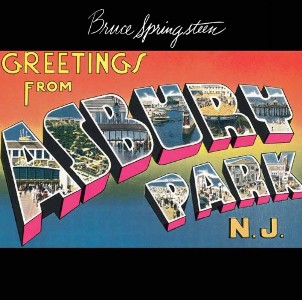
This wonderful record starts with an archetypal early Springsteen track. The twisting high guitar lines that are joined by a wailing sax line lead into a lyrical blunderbuss of a track: Blinded by the Light. Bruce uses internal rhymes throughout the song
In the dumps with the mumps as the adolescent pumps his way into his hat...
Some brimstone baritone anti-cyclone rolling stone preacher from the east
He says, "Dethrone the dictaphone, hit it in its funny bone, that's where they expect it least"
It's a joy, and it's worth saying that it is much better than the godawful cover by Manfred Mann from 1976. As I said, it's the archetype of this time: lyrically dense, musically diverse and energetic. What he would do further would add more sections to his songs so they felt like a meeting point of different tunes. The next tune on the record, Growin' Up, is similar, the internal rhymes crossing over each other in this tale of coming of age.
And I pushed B-52 and bombed 'em with the blues with my gear set stubborn on standing
I broke all the rules, strafed my old high school, never once gave thought to landing
It came from the ashes of an earlier song, Eloise, which obviously sound the same but isn't quite as dense in it's language [I only know of that 1 minute outtake so who knows if there's more than this]. Musically it's fairly simple, originally rolling around a picked and then strummed pattern around F, C and G for the most part, which David Sancious copies on piano, and it was one of the songs that sold Columbia on signing him. It's blasted out by Springsteen, and became a focal point of live concerts [Brucebase has it being performed 606 times at the time of writing], including the famous 1978 version with the long spoken section for his parents ["Hey, Ma, give it up!"].

The Dylan influence

These songs of mine, they’re like mystery stories, the kind that Shakespeare saw when he was growing up. I think you could trace what I do back that far. They were on the fringes then, and I think they’re on the fringes now. - Bob Dylan[2]
Springsteen was signed partly on the strength of some acoustic solo performances and this is seen on Mary Queen of Arkansas. It evidences the influence of Dylan on his work, I think, and is a powerful song, hinting at the dreamer that would be more evident in his later work ["Oh, the big top is for dreamers, we can take the circus all the way to the border"].
Does This Bus Stop at 82nd Street? is a joyful song, taking this rhyme-dense approach about as far as it can go. Look at the rhymes and half rhymes that litter the first verse, for example:
Hey bus driver, keep the change, bless your children, give them names
Don't trust men who walk with canes
Drink this and you'll grow wings on your feet
Broadway Mary, Joan Fontaine, advertiser on a downtown train
Oh, Christmas crier bustin' cane, he's in love again
I don't know how long he could keep this up for before he literally runs out of words to rhyme, but the next album saw a slightly different approach to his songwriting as we'll see. It's an enjoyable song. Interestingly, it wasn't performed live from 1976 until early 1993.

Springsteen's imagery

Lost in the Flood is a brilliant song, and one I can't imagine Bruce writing post 1978. It's a bursting with interesting and strange imagery, most of which I think he uses because it sounds good rather than having any deeper meaning ["And everybody's wrecked on Main Street from drinking unholy blood/Sticker smiles sweet as gunner breathes deep, his ankles caked in mud"]. The band kicks in as Springsteen sings "Jimmy the Saint" and they sound great. A piano driven song centred around a few simple chords, Springsteen uses it to paint a dramatic picture ["Hey kid, you think that's oil? Man, that ain't oil, that's blood"] and the music works perfectly.
The Angel and For You which follow are both great numbers, different in their approach. The Angel is another Springsteen acoustic number, whilst For You is a piano led four piece rock song, but they share flamboyant lyrical flourishes like alliteration ("hubcap heaven", "precious pavement", "humpin' his hunk metal whore", " I stand stuffed like some soldier undaunted").
Up next, we see the return of Clarence and his sax with Spirit in the Night. I think this track points to the expanding storytelling of the next albums, full of characters like Crazy Janey, Wild Billy and G-Man and their adventures up at Greasy Lake. Live it often expands into a longer performance, slowing down to almost full stop in the middle, like the amazing performance at the Hammersmith Odeon, 1975.

The album is completed by the superb It's Hard to be a Saint in the City, a song that rolls around dark alleyways, revving its engine, until it burst out onto the street ["I had skin like leather and the diamond-hard look of a cobra"] snarling and vicious, lyrically explosive and plosive ["I was the prince of the paupers crowned downtown at the beggar's bash"]. Bowie had a go at this, which doesn't work to my ears, but it's always worth revisiting.
From this partially solo album Bruce's backing band were emerging properly. The E Street band, who had been backing him for a good year or so, were given the chance to appear on his next record.

Get the album

Or you can download it or stream it.


Notes

[1]: Alleged response by Hemingway to a comment by William Faulkner, circa 1947
[2]: Speech given at the MusiCares Person of The Year award, February 2015

Sunday, 12 April 2020

Lions and Tigers and Bears? (Me) Oh My!

Cate Le Bon - Me Oh My (2009)

Cover of the Cate Le Bon album, Me Oh My
Click image to buy
I hold a beast, an angel, and a madman in me, and my enquiry is as their working, and my problem is their subjugation and victory, downthrow and upheaval, and my effort is their self-expression. - Dylan Thomas[1]
How to travel during the Coronavirus lockdown? This is why we listen to music, it transports us, although it won't always take you to where you hope to go.

Cate Le Bon came to my attention following one of my strange completist phases. I had noticed I was enjoying more and more female singers: Joanna Newsom, Angel Olsen, Courtney Barnett, Agnes Obel, St Vincent, Flo Morrissey and Aldous Harding (this list could go on). What was it about them that garnered my attention? Apart from their marvellous voices I think it was their clear individuality. I had grown up listening to a lot of men singing, and enjoyed it. As a teenager I'd had my embarrassing "masculine" phase (I owned an album by the Vinnie Vincent Invasion) but thankfully The Beatles and The Stones had pulled me away from that brink. I discovered James Brown, George Clinton and then Prince. I hit my twenties during that period where Public Enemy stood above everyone else in the rap game. I started to delve under all sorts of musical rocks at this time, collecting a range of music, no genres were off the table (Elton John was off the table). I'd grown up the child of two soul fans, so it seemed natural to me to listen to well known artists like Aretha Franklin, and the obscure sides of the Swan label. And most importantly, I liked what I liked, not thinking about anything like gender. It wasn't important, what mattered was good music. So, of course, some of my soul sides were sung by women, but I don't think a huge amount else was. The two female artists that stick out in my mind that I often listened to were Kate Bush and PJ Harvey. Both brilliant and compelling but rarities in my record collection. I'm now at that stage where my collection has smeared into one hazy memory so I can't always remember when artists came into my view. But I have to be honest: there weren't a huge number of females in my collection. Even Cat Powers' The Covers Record was probably a bit of safe ground - songs by artists I knew interpreted by a female singer.

An undiscovered country

There was no overarching plan here. I collected music that was well reviewed (often by men) and well renowned (often by men). I bought stuff I enjoyed. Nowadays every streaming site has an 'artists like this' link allowing you to explore new and old musicians. In my youth this was done through the NME, Melody Maker, Mojo and then Uncut. I listened to what I could discover, but I didn't work too hard at it. And then one day I discovered I had been listening to music by women all along. It had appeared in my music collection and was some of the best stuff I owned: Time (The Revelator), the aforementioned Covers Record, Punishing Kiss by Ute Lemper(I think I'll do a post about this one day), Bavarian Fruit Bread by Hope Sandoval and more. Whist I hadn't consciously avoided female-led music, I came to a decision to consciously enquire further. I was enjoying music created by women more than anything else I was listening to. And somewhere in that journey I found Cate Le Bon.
Cate Le Bon is a Welsh singer and songwriter who most definitely deserves your attention. No relation to Simon, she's a quirky and unique folk singer.


Thoughts on Me Oh My

Her first album plays out over spooky, phased guitar lines and dramatic crescendos.

Me Oh My

Our first introduction to the phased guitar that picks out a tune underneath the nursery rhyme song and lyrics. A delightful minor key folk piece that sets the scene for what is to come. The middle eight section is an instrumental, laughing, mocking synthesiser and the Le Bon jumps back in, a glassy voice an octave up from before. The synthesiser returns and then it's brought full circle, her voice low and back with the opening lines leading to an expansive, free ending, cymbal crashing, synth growling.

Sad Sad Feet

Here Cate Le Bon sounds out her influence - a Super Furry Animals melody over strummed guitar. A beautiful folk song that takes us into Le Bon's dark territory "It's just, baby, I'm headed for the black". 

Shoeing the Bones

To hear Le Bon sounding confident and in control is a thing of beauty as she intones a poem-like lyric over her guitar, her melody rising and then returning to the main key for each couplet. The song builds to a coda that in another time could become a group singalong, "These are hard, hard times," but here she repeats it alone, then falls away to a single guitar line.

Hollow Trees House Hounds

The band all kick in to this track, driven by an Edwyn Collins like fuzz guitar that ties together the lines of this danceable song. A high guitar line copies the melody most of the time, again slightly phased it wobbles alongside her voice looking for an opening and finds it as a stabbing note over and over after the chorus. Le Bon sounds folky, imperious. The voices (all Le Bon?) meld together in the swell before a final verse that rounds everything off perfectly. It's a pop song hidden as spooky folk piece.

It's Not the End

We are brought back to a simple folk song after the mania of the previous track, guitar and accordion (or harmonium) support her incredible voice. A slight song, this one, feels like a breath before the next numbers.

Terror of the Man

Keyboard driven, the melody line is picked out on the harmonium sounding keys before Le Bon's dramatic voice enters to describe the situation, the terror. Over a single kick drum snapping.
Spread fire through the grounds
Obliterate the towns
But spare us from the sounds
Another song that builds, and after around 2.15 minutes the whole band explode into a hypnotic charge - Terror of the Man is repeated seven times - is this a charge against male dominated problem in society (Make frightening plans, And see them with your hands) or is that a simplistic reading of the song? When Le Bon sings in her higher register she sound cold, icy and aloof, but always in control, and she chooses her voices well.

Eyes So Bright

A love song. The magic of Le Bon is in full force on this one. The acoustic gently rolls out blocked chords and that phased keys in the background. Cate Le Bon's sings a song for her sister, but is she perhaps a horse in this one, "I ride behind, keeping hounds in line" she sings, and I can't help imagining the hunt taking place: "Mark its time, it's a terrible time". It enters its final phase with another repeated line, "I love you" which is distant enough to not sound cliched and ragged enough not to sound trite.

Digging Song

Strange Welsh folk as gorgeous pop music, Digging Song has a delightful, hummable melody that could sit over a great 80s arrangement if it wanted to. Here is sits atop guitar and harmonica. The harmonica copies the melody line after the verse which is another songs that bring to mind the land, the earth with its reference to digging, but of course, in a hip world "dig" means something else too. "And I dig all night with tired eyes". The joy of Le Bon's music is that it invokes the country with ease, but also makes you questions your interpretation - perhaps she's not singing about what I think she's singing about. Where is she taking me with this? Ultimately the melody is strong enough to enjoy on its own and take you away from questions of interpretation which don't necessarily enhance the song anyway. I'd play this track and just smile.

Burn Until the End

Opening chords like an Elliot Smith song, but that all changes when Le Bon brings in her Nico-like descriptive vocals. She pleads in her higher register before a manic episode with a wailing guitar that blows like a flag in the wind over a cantering rhythm. The dust settles and she continues, "I want to burn until the end"...

Out to Sea

An opening line like "When the tide comes in" sounds almost like a folk cliche, but it is carried off well because Le Bon's imperious vocals means she sounds like she is stood high above, looking at the sea. Even when she feels unsure...
And if I head for ground
Fearing I may drown
...there's never a time she doesn't seem in control.

Thursday, 9 April 2020

It's High Time we talked about Detroit, Michigan

MC5 - High Time (1971)

Click image to buy
Detroit's just a great place. It started with the music that I like, but the whole area (is great). I like to go up to Mackinac and fish. I got a lot of reasons to like Detroit, but most of all, the music has always been the greatest part. I've been working with the kids - George Clinton [1]

Late 60s Detroit is a place that exists best in my imagination.. I picture it as normal to see the odd Motown star strolling into the studio at 2648 West Grand Boulevard and hear Berry Gordy's particular brand of driving soul pouring from every radio and car window. Obviously this is not the case, and Gordy himself felt that the Motor City had given him all that it could when he started the process of moving out to Los Angeles, but any place that births the music of Stevie Wonder, Funkadelic, Iggy Pop and the MC5 is going to be alright by me.
So, of course, I picture myself studying at the University of Michigan and getting the opportunity to see these great bands (and Ted Nugent) in the flesh. Late 60s Parliament must have been a pretty incredible sight as George Clinton broke away from the Motown mould to get funkier, dirtier and nastier. And quite simply cool.
Clinton was on Revilot records, home of Darrell Banks and the wonderful Debonaires, both of whom will feature in future posts. After a few non-hits for The Parliaments the label dropped Clinton. He later emerged on the Invictus label and by then Parliament had become as heavy a funk band as could be heard. Their sound was influenced by The Stooges and the MC5 as Clinton said in 2016: "Oh, we played with them all the time. ...We saw that Detroit had its own version of rock 'n' roll coming out. They influenced us a lot." [1]

As Clinton was twisting the Motown sound the MC5 were updating rock and roll, trying to play their own sonic versions of surf tunes and R&B classics, like James Brown's I Don't Mind. To my uneducated ears, their early tracks have the sound of The Who, and you can hear that even in 1966 they have a sharp, energetic crashing sound that has that wonderful cheap mid-60s production that makes drums sound like shoeboxes and some sort of wood block knocking out little triplets.

An album whose musical value doesn't quite equal it's shock value[2]

I first started listen to the MC5 by discovering their debut, live album, Kick Out the Jams. I think most people growing up in the late 80s who were trying to understand the history of punk music were led to Kick Out the Jams. Funnily enough, I wasn't too enamoured by the record. It was alright, which is good enough for me, but often seen as a criticism nowadays. I particularly liked Rocket Reducer and album opener Ramblin' Rose with it's declaration:
"Brothers and sisters, I wanna see a sea of hands out there. I want everybody to kick up some noise. I wanna hear some revolution... Brothers and sisters, the time has come for each and every one of you to decide whether you are going to be the problem or whether you are going to be the solution! You must choose, brothers, you must choose. It takes five seconds - five seconds of decision, five seconds to realise your purpose here on the planet. It takes five seconds to realise that it's time to move, it's time to get down with it! Brothers, it's time to testify. And I want to know - are you ready to testify? Are you ready? I give you a testimonial. The MC5!"

Back in the USA

The MC5's second album is called Back in the USA. It's a mixed bag for me, because their covers don't really work. Let's me be honest, I have never heard a version of Tutti Frutti that works, other than the original, of course, and on this one Rob Tyner's voice just cannot carry the song. The tracks the band write are all pretty good, and for me the stand out tracks are Call Me Animal, The American Ruse (this is what 3-chord garage rock should sound like) and The Human Being Lawnmower.
But what I want to discuss is the third album.

High Time

Sister Anne

This blasts into existence with a deep opening chord, followed by a riff that leads into a great rock'n'roll groove that drops into that wonderful genre of songs that describe some mysterious woman, slowly giving us more and more information about "every man's saviour". The harmonica (Rob Tyner) screams along after a superb 'Sonic' Smith solo. The song wails like a ramshackle gospel chorus stopping but not stopping, as the riff bursts out at the end, a choir of backing singers repeating "She's my Sister Anne" over a feedback driven collapse. Out of the crumbling collapse marches a band of trumpet, trombone, flugelhorn, tuba and bass drum.

Baby Won't Ya

This one snarls out of a riff that the rock bands of the mid to late seventies would have loved. It's clear that this album is less political than the earlier stuff, but for sheer entertainment it wins for me. The chorus of this one apes Dylan's "Baby Let Me Follow You Down". The twin guitars of Fred Smith and Wayne Kramer twist around each other perfectly in the solo, building to the final verse and another run through the chorus. The song becomes choppier and choppier, with everyone fighting for space as the song slowly fades out.

Miss X

A Wayne Kramer piano riff, copied by the guitar leads out this anthemic track that Kramer himself wrote, which is an undiscovered mid-70s classic rock track. Actually atypical MC5 stuff, and I can imagine any fans of the band from the early days feeling a bit let down by this one, which seems like a template for Guns 'n' Roses and a millions other radio friendly rock bands This could have easily been a hit, but it seems like no singles were released from this record.

Gotta Keep Movin'

Back in the land of garage rock and roll here, 3 chords Mouse and the Traps like groove, touching on the political in a simplistic way
Presidents, priests and old ladies too
They'll swear on the Bible
What's best for you
Atom bombs, Vietnam, missiles on the moon
And they wonder why their kids are shootin'
Drugs so soon
It sounds like it would be quite at home on the Nuggets sets and it wins wiht a delightful solo after 2 and a half minutes that then brings in the second guitar as they fight it out to the end over the top of Dennis Thompson's rolling drum fills.

Future/Now

From a bouncing, moody bass line this one feels more like it's rooted in the heavier supergroups like Cream and rather than being derivative it demonstrates how versatile the band were. And this track enjoys another monster drum pattern from Thompson, even if they are recorded to sound a bit dull.
The guitars dance left and right through the opening 3 minutes. A shout of "The key to the mystery" by Tyners brings everything to a calm stop. Reverbed guitars play quite little patterns into the more psychedelic section of the song. Tyner's voice clearly warping through a Leslie cabinet or some other processing as it washes in and out. All of this is designed to demonstrate the birth of a new future:
A strange new day for the people of the Earth
Traditions, burned away by the rising sun
It's a bit of a weak ending to a song that starts so well, and sounds like an unfinished idea of Tyner's to me.

Poison

A staccato riff pushes the band through another great rock track. The real star here is Michael Davis's bass that bounces under a track that sounds like it would not be out of place on one of the Norman Whitfield experimental soul-rock tracks for The Undisputed Truth. This has one of my favourite guitar solos on the record, blistering out of the speakers after a minute and a half. Tyner brings everything down quietly after that, which works more successfully than Future/Now because of how the anger returns with a final verse.

Over and Over

The MC5 channeling The Who on the brilliant track. Electric and acoustic guitars vie for space after a neatly picked, wobbly opening and another bass riff from Davis. Tyner sings this well, setting out his frustrations with technology and revolution when views through the lens of real life where "he cat next door spends all his time trying to think up new antisocial crimes" and "I was working in a factory, over and over, just trying to make it satisfactory". It's not a Springsteen like tale of working the factory floor but more like another of songwriter Smith's free association of rhyming ideas
The cop on the street wants us down on our knees
The president says we've got to have peace
The whole thing works because it rocks it's riffs so well and the Townsend like clangs of the acoustic guitars drive the whole things on incessantly.

Skunk (Sonicly Speaking)

Drums, drums and more drums. The "sonicly speaking" sounds thunder out at the start of this, Thompson's drums joined but an array of percussion for a good minute until Smith and Kramer hop on board with a great garage rock riff. It's more 3-chord stuff that the MC5 could do so well. This is the kind of music you can imagine just killing on stage. The drums rumble along non-stop and allow the rest of the band to open up properly. More dumb but fun lyrics carry the song along until out of nowhere a horn section appears, neatly bookending things after the horns of Sister Anne. These horns feel more free association, a touch of Albert Ayler's Music is the Healing Force of the Universe rather than the marching band sound. Funnily enough, Ayler started life off with a marching band sound which opened up to more freedom as time went by, and the horns on this album seem to do the same.

I haven't found any of this music on any bootlegs, even though the band continued to tour for a good year after this before breaking up in 1972. There were reunions (although all after Tyner had died) and I'm not a big fan of these things. According to wikipedia Wayne Kramer was leading some sort of "MC50" tour with him and "rock stalwart" that surely no-one needs to see.

Buy this music


[1]: https://www.metrotimes.com/detroit/george-clinton-lays-it-all-down/Content?oid=2441830  
[2]: Richie Unterberger: Music USA The Rough Guide

Monday, 6 April 2020

Somethin' Else to listen to

Cannonball Adderly - Somethin' Else (1959)

Click image to buy
"Is that what you wanted, Alfred?"
Recently, I've been listening to a lot of Miles Davis, and this led me on to Cannonball Adderley.

I like the fact that Miles Davis allows Cannonball to really shine here. Often Miles sticks to the main melody giving Adderley the chance to deviate and solo in a more dramatic way. Miles' understated performance is key to the whole album.
Is this a masterpiece?

Autumn Leaves

Starts with lovely echoing piano notes and then Miles Davis' perfectly noted trumpet plays the melody. Adderley comes in after about 2 minutes, immediately stretching the melody. It has what I would feel is that 'cool' jazz sound: walking bass from Sam Jones, hissing ride cymbal from the masterful Art Blakey and busy but not fussy horn playing. Davis was already a big star at this point helping out one of his sidemen. The sound of Miles' trumpet is one of the things that drew me into jazz. There is a lovely, bluesy lick that both he and Cannonball play in this piece which just feels so right, and Miles' solo is quite wonderful.
In the final 2 minutes there is a lovely, piano led coda that returns to the mysterious latin-like groove that starts the song. Hank Jones on the piano, here. Looking through my records I only have one album by him: Lazy Afternoon from 1989 (will post about it someday) so it looks like I have to start delving into the work of someone else soon.

Love For Sale

The melodic intro suddenly 'pings' into a shuffling and sexy groove. Again, Miles starts off squeezing out the melody notes over a beat that makes me want to samba (or is it rumba? I know nothing about these dances, it's probably a foxtrot for all I know). Cannonball plays much faster than Miles, adding an extra zip to the tune with his runs up and down the scales and the drumming soon falls into line. As a jazz novice I love how far away from the melody the sax seems to wander, and how the trumpet comes back, restrained, to the original tune. This is a real 'standard' with versions by Dexter Gorden, Sidney Bechet and an upbeat version by Miles own sextet on the '58 session album. This version contrasts with the Davis sextet by being slightly slower, which is necessarily better, but the piano lines are what make it for me. Little riffs on with the left hand makes it so danceable.

Somethin' Else

No need for a groovy intro - this swings right in - sax and trumpet talking to each other, swapping notes, until Miles takes over with a great solo taking in some nice high notes but never too busy.
As Cannonball plays his solo the tune is moving along quite briskly and there's a wonderful moment about 4 minutes in when Art Blakey does this kind of double time rat-a-tat with his high hat. The sax never loses its stride.
My favourite moments are when the two horns battle away ('trade licks' they usually say in books and magazines). Not sure I understand enough about music to enjoy the piano solo here - I would prefer more notes and less chords!

One for Daddy-O

A mix of delicious piano and side-by-side horns brings this one in and it then blasts with a bluesy Cannonball solo that I just love.
The bass (Sam Jones) picks out a quite perfect line here, I love the more metallic high notes that pop up from time to time. Miles' solo is fantastic too. After my moaning about the piano on the last track, Hank Jones plays just what I want on this one, fingers snaking up and down the keyboards, slurring notes everywhere. By the time the piece returns to its main theme every musician has shown their talent and ability perfectly.
"Is that what you wanted, Alfred?" is Davis to producer Alfred Lion, who had a measly few paragraphs written about him on Wikipedia which is a bit odd considering he co-founded Blue Note.
Alfred Lion and Hank Moberley (found at Times of Israel)

Dancing In The Dark

Smoother, melodic, time for a slow dance. Adderley is so expressive during the opening bars it makes me want to weep. The descending scales are blown so perfectly to these inexperienced ears - this is Cannonball's track.

Alison's Uncle

A double horn blast into the main theme and everyone's up and at it on this one, which just barrels along. This was recorded in 1958 but not released, what a shame! And how great we do get to hear it, because both horns play great solos, especially Miles. Art Blakey gets a few nice solos on this one; I'm not too keen on drum solos but these are nice and quick and set the tune up for a bopping finale!

Somethin' Else get a showing in the Penguin Guide to Jazz Recordings Core Collection. Adderley's most famous record, but not necessarily his best. For me, that goes to The Black Messiah.

Buy this music

Buy the CD from Amazon
Buy the MP3 album from the Amazon Digital Store
Have a listen to the album on Google Play

Sign up to my Substack